

Personalised intimacy: your guide to deeper connection
TL;DR:
- Personalized intimacy involves tailoring connection and pleasure to individual needs through honest communication and boundary negotiation. It emphasizes understanding personal erotic blueprints, emotional, and energetic needs to foster consistent, fulfilling relationships. Digital tools can support but should complement genuine vulnerability and face-to-face interactions.
Intimacy is not a single, universal experience. Yet most advice treats it as though one approach fits everyone, leaving countless people feeling misunderstood or quietly dissatisfied. Personalised intimacy challenges that assumption entirely. Rather than following scripts handed down by magazines or well-meaning friends, it asks you to look inward, communicate honestly, and build a shared language of desire that belongs only to you and your partner. This guide walks you through the frameworks, science, and practical tools that make deeply satisfying connection not just possible, but repeatable.
Table of Contents
- What is personalised intimacy?
- Mechanics and methodologies: how personalised intimacy works
- The emotional science behind personalised intimacy
- Edge cases and digital dynamics: when personalisation goes further
- Why authentic communication is the true foundation of personalised intimacy
- Explore discreet tools for your tailored intimacy journey
- Frequently asked questions
Key Takeaways
| Point | Details |
|---|---|
| Personalised intimacy defined | Tailoring emotional and physical connection to unique desires supports fulfilling relationships. |
| Practical tools available | Frameworks and apps like erotic blueprints and Dr. Bloom can guide you to discover your needs. |
| Communication is vital | Technology enhances but cannot replace honest conversation and negotiated consent. |
| Risks of over-personalisation | Relying too much on digital solutions can limit authentic intimacy; balance is key. |
What is personalised intimacy?
Personalised intimacy is the practice of tailoring connection and pleasure to suit your own emotional and physical needs, as well as those of your partner. It moves away from the idea that desire is standard or predictable, recognising instead that every person carries a distinct combination of turn-ons, boundaries, and emotional requirements.
Traditional models of intimacy tend to rely on routines, generic advice, or mass-market scripts. These approaches often work for a while, but they rarely account for how individual preferences shift over time or differ dramatically between partners. Personalised intimacy, by contrast, treats your relationship as a living, evolving dialogue rather than a fixed formula.
At its core, this approach rests on three foundations:
- Explicit communication: Naming what you want and what you do not want, clearly and without shame.
- Boundary negotiation: Agreeing on limits that feel safe and revisiting them as trust grows.
- Responsive aftercare: Checking in after intimate experiences, using reset phrases or rituals that help both partners feel secure.
“Mechanics and methodologies include explicit negotiation of boundaries, personalised arousal mapping, structured aftercare with reset phrases, customised commitments, and tools like erotic blueprints or intimacy coaching apps.”
One of the most useful frameworks here is the erotic blueprint model, which identifies five core styles: Energetic (aroused by anticipation and space), Sensual (needing all senses engaged), Sexual (turned on by nudity and direct stimulation), Kinky (excited by taboo or power dynamics), and Shapeshifter (a blend of all four). Knowing which blueprint resonates with you, and which resonates with your partner, gives you a shared map rather than a guessing game.
Practising intimate self-care is part of this process too. Understanding your own body and emotional landscape makes it far easier to communicate your needs. Exploring intimate accessories thoughtfully chosen for your preferences can also support that self-knowledge, adding a tangible dimension to what might otherwise remain abstract.
Mechanics and methodologies: how personalised intimacy works
Knowing what personalised intimacy is only gets you so far. The real shift happens when you start putting it into practice. Here is a straightforward sequence to follow:
- Explore your blueprint. Take an erotic blueprint quiz individually, then share results with your partner. Avoid judging each other’s styles.
- Map your desires. Each partner lists what genuinely excites them, what they are curious about, and what is firmly off the table.
- Set and negotiate boundaries. Use a traffic-light system: green for enthusiastic yes, amber for willing to try, red for hard no.
- Agree on aftercare. Decide in advance how you will reconnect after intimate experiences, whether that is a specific phrase, a warm drink, or simply holding each other quietly.
Digital tools can support this process meaningfully. Apps such as Dr. Bloom offer guided communication exercises and desire-matching features that reduce the awkwardness of starting these conversations from scratch. Tools like erotic blueprints and apps enable personalised guidance and matching of desires, making it easier for couples to identify where they overlap and where they diverge.
The contrast between personalised and generic approaches is significant:
| Approach | Focus | Outcome |
|---|---|---|
| Generic advice | Average preferences | Inconsistent satisfaction |
| Personalised intimacy | Individual needs and desires | Consistent, evolving fulfilment |
| App-guided frameworks | Structured dialogue | Reduced miscommunication |
Learning about erotic blueprints gives couples a shared vocabulary that makes these conversations feel less exposing and more collaborative. Understanding how adult toys and intimacy interact can also open new avenues for exploration, particularly when both partners approach it with curiosity rather than expectation.

Pro Tip: Start with low-pressure conversations, perhaps during a walk or over dinner, rather than in the bedroom. Introducing new ideas in a relaxed setting removes performance pressure and makes honest dialogue far more likely.
The emotional science behind personalised intimacy
The case for personalised intimacy is not just intuitive. Research backs it up with striking clarity.
Studies show that sexual closeness discrepancies predict decreases in sexual satisfaction and orgasm frequency. In other words, when partners want different levels of closeness and neither acknowledges it, both suffer. The gap does not close on its own.
Emotional intimacy and sexual intimacy are related but distinct. You can feel deeply bonded with someone emotionally and still feel sexually misaligned, or vice versa. Both matter, and both require separate attention. Emotional intimacy is strongly linked to relationship satisfaction, especially for women, which means that addressing emotional needs is not optional if you want a genuinely fulfilling connection.
The four energies of intimacy model adds another layer. It identifies Emotional, Playful, Sensual, and Primal energies as the building blocks of lasting connection. Most people have a dominant energy, and understanding yours helps explain why certain experiences feel deeply satisfying while others leave you cold.
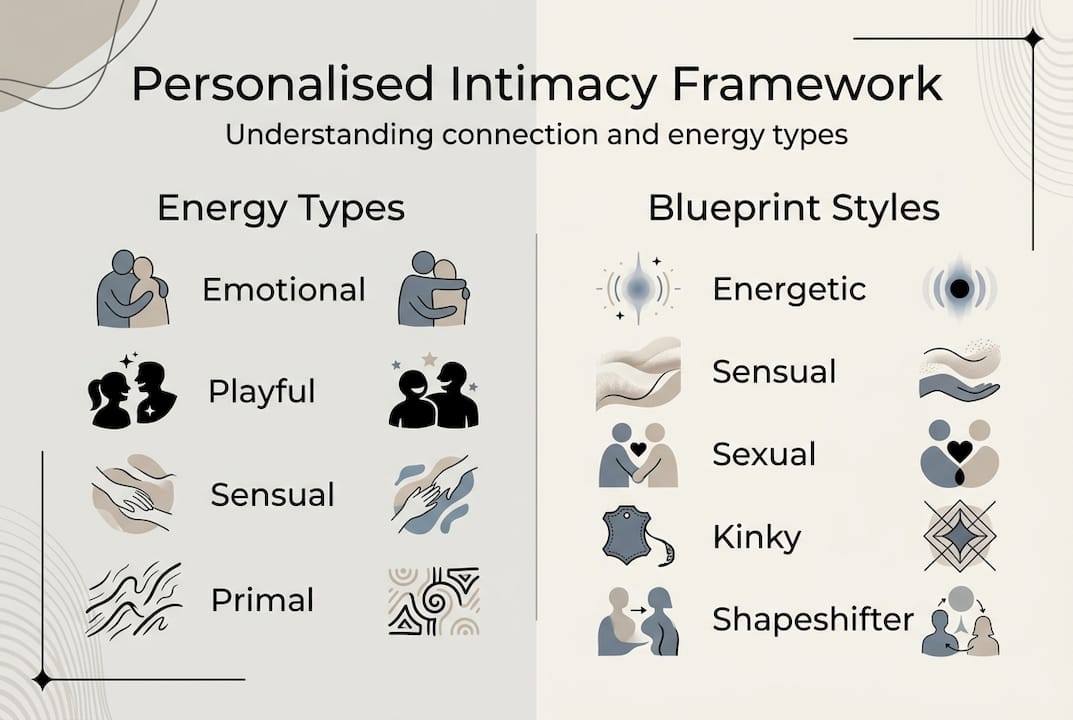
Here is a snapshot of how these energies tend to show up:
| Energy type | Core need | Common expression |
|---|---|---|
| Emotional | Safety and vulnerability | Deep conversation, eye contact |
| Playful | Fun and spontaneity | Laughter, games, surprise |
| Sensual | Physical comfort and beauty | Touch, scent, atmosphere |
| Primal | Raw desire and intensity | Passion, urgency, physical presence |
Key findings from the research include:
- Couples who align emotional needs report significantly higher satisfaction.
- Mismatched closeness expectations are a stronger predictor of dissatisfaction than mismatched sexual frequency.
- Non-monogamous and relationship-anarchist structures require even more deliberate personalisation, as the emotional and sexual dimensions are often managed across multiple relationships simultaneously.
Investing in emotional self-care is therefore not a soft extra. It is a measurable contributor to the quality of your intimate life.
Edge cases and digital dynamics: when personalisation goes further
For most couples, personalised intimacy means better communication and thoughtful exploration. But for those in consensual non-monogamy (CNM) or relationship anarchy (RA), personalisation becomes considerably more complex.
In these structures, edge cases like relationship anarchy and CNM distinguish carefully between emotional and sexual intimacy, and contrast sharply with standardised expectations. Managing multiple intimate connections requires advanced negotiation skills, clear agreements about what is shared and what is private, and a willingness to revisit those agreements regularly.
Digital tools are increasingly part of this landscape. Apps, AI companions, and online communities offer new ways to explore desires and find connection. However, the risks are real. AI companions risk illusions of intimacy that lack true reciprocity, with digital tools sometimes promoting maladaptive strategies. An AI can mirror your language and preferences convincingly, but it cannot genuinely know you or grow with you.
The distinction matters:
- Authentic interaction: Involves real vulnerability, genuine unpredictability, and mutual growth.
- Algorithm-driven mirroring: Reflects your inputs back at you, creating comfort without true connection.
- Ethical digital use: Using apps to facilitate conversation between real partners, rather than replacing those partners.
Using digital intimacy tools thoughtfully means treating them as bridges to better human connection, not as destinations in themselves.
Pro Tip: Always prioritise consent and open, offline conversation. Apps and AI can spark ideas, but the real intimacy happens when you put the phone down and talk honestly with the person in front of you.
Why authentic communication is the true foundation of personalised intimacy
Here is something the frameworks and apps will not tell you: all the tools in the world cannot substitute for the moment you choose to be genuinely honest with your partner.
Personalisation must not replace human vulnerability. Blueprints, tables, and apps are scaffolding. They help you organise your thoughts and start conversations you might otherwise avoid. But the breakthrough comes when you risk saying something true, something that might be rejected, and your partner meets you with curiosity rather than judgement.
We have seen this pattern repeatedly. Couples who invest heavily in tools but avoid real emotional honesty tend to plateau. They optimise the surface while the deeper connection stagnates. Over-reliance on tech personalisation risks shallow bonds and genuine psychological pitfalls, particularly when digital comfort replaces human risk-taking.
The most satisfying intimate relationships we encounter are built on mutual discovery, the willingness to say “I am not sure what I want yet, but I want to find out with you.” That kind of openness cannot be downloaded. Thoughtful gifting for connection can be a lovely gesture of care, but it works best when it accompanies honest conversation rather than replacing it.
Explore discreet tools for your tailored intimacy journey
Putting personalised intimacy into practice is easier when you have the right tools to hand. Whether you are just beginning to explore your blueprint or looking to add a new dimension to an established relationship, quality matters.
At Intimate Elegance, we curate products designed to support genuine exploration rather than generic novelty. Our sex tip cards are a playful, low-pressure way to open conversations and discover shared interests. For those drawn to sensory experience, our lace mask adds an elegant dimension to sensual play. Every order ships discreetly across the EU, so your privacy is always protected. Explore at your own pace, with confidence.
Frequently asked questions
How do I discover my erotic blueprint?
Frameworks like the erotic blueprint identify five core styles, so start with an online quiz, then explore the results with your partner or use an app like Dr. Bloom to match preferences and guide your next conversation.
Is personalised intimacy helpful for solo individuals?
Absolutely. Personalised approaches benefit both individuals and couples, and understanding your own desires is the essential first step whether you are exploring alone or with someone else.
Are there risks to using AI intimacy tools?
AI companions can be useful for sparking ideas but may foster shallow bonds if overused, so always pair digital tools with genuine, face-to-face communication.
How can sex toys support personalised intimacy?
Purpose-designed accessories enhance intimacy by aligning with your personal needs, helping individuals and couples explore desires in a tangible, communicative way.
Recommended
- Intimate gifting: Enhancing connection, privacy and wellness – Intimate Elegance
- Intimate self-care: Enhance pleasure and wellness holistically – Intimate Elegance
- Intimate wellness: what it means and why it matters – Intimate Elegance
- What is an intimate accessory: enhance your intimacy – Intimate Elegance