

What is sexual self-expression: a guide to authentic sexuality
TL;DR:
- Sexual self-expression encompasses thoughts, feelings, and behaviours that communicate and experience personal sexuality throughout life.
- It benefits physical and mental health by reducing stress, supporting immunity, and fostering emotional trust and confidence.
Sexual self-expression is the authentic process of communicating and experiencing your own sexuality through thoughts, feelings, desires, and behaviours. Far from being a fixed state, it is a lifelong practice of self-discovery that touches your mental, emotional, and physical well-being in measurable ways. Research confirms that regular sexual activity reduces cortisol, supports immune function, and triggers oxytocin release. This means that understanding sexual self-expression is not simply a matter of personal curiosity. It is a genuine pillar of holistic health, and one that deserves the same attention you give to sleep, nutrition, or exercise.
What is sexual self-expression and what does it encompass?
Sexual self-expression, known in clinical and academic contexts as sexual self-understanding, covers the full spectrum of how you relate to your own sexuality. It includes your desires, your boundaries, your identity, and the way you communicate all of these to yourself and to others. The concept is not limited to physical acts. It reaches into your emotional life, your psychological patterns, and the sociocultural context you inhabit.
Sexual self-expression evolves continuously, shaped by internal reflection and the world around you. This matters because many people approach sexuality as though it were a destination rather than a process. Treating it as fixed creates unnecessary pressure and often leads to shame when desires or preferences shift over time.
The components of sexual self-expression include:
- Physical expression: how you experience pleasure in your body, whether alone or with a partner
- Emotional expression: the feelings you associate with intimacy, desire, and connection
- Psychological expression: your beliefs, values, and internal narratives about sexuality
- Relational expression: how you communicate needs, boundaries, and desires with others
- Identity expression: your sense of sexual orientation, gender, and attraction
Experts in sexual health increasingly advocate a biopsychosocial model that moves away from dysfunction-focused clinical thinking and towards recognising pleasure as a fundamental component of health. This shift is significant. It means that exploring your sexuality is not a luxury or an indulgence. It is a recognised dimension of human wellness.
What are the benefits of embracing sexual self-expression?
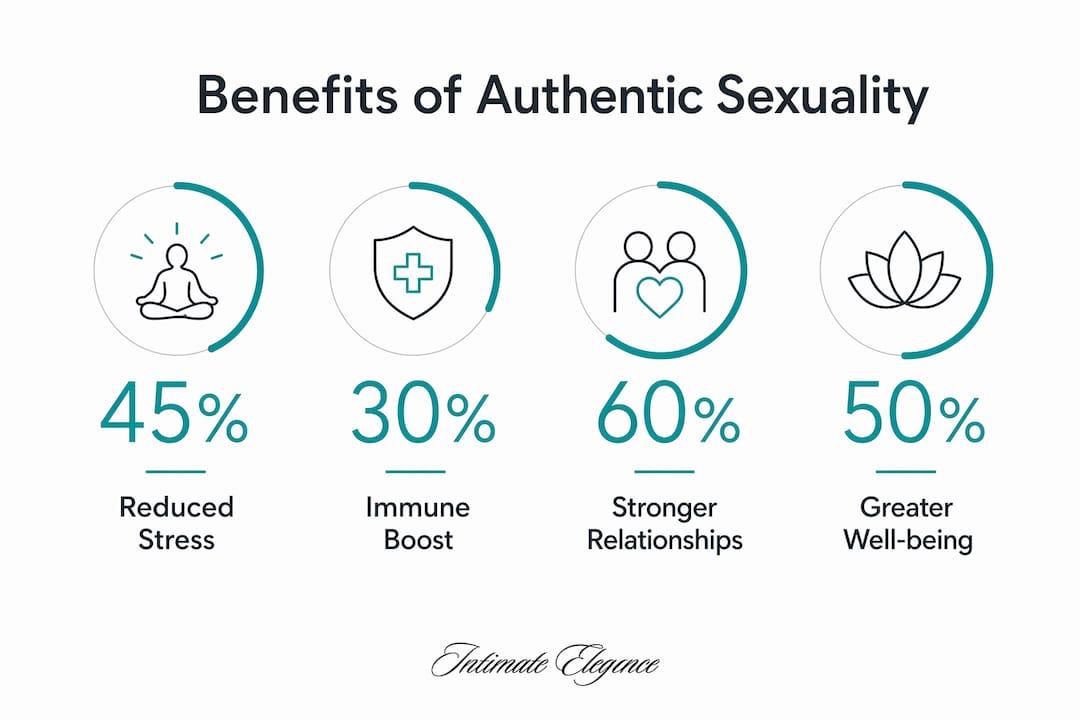
The benefits of sexual self-expression extend well beyond the bedroom. Scientific evidence points to a clear connection between healthy sexual expression and improved physical and psychological health outcomes.
Cortisol reduction and immune support are among the most consistently documented physiological effects of regular sexual activity. Lower cortisol means less chronic stress, which has downstream effects on sleep quality, cardiovascular health, and mood regulation. Oxytocin, released during intimacy and orgasm, strengthens feelings of trust and emotional bonding, whether with a partner or simply with yourself.
The Kinsey Institute has documented that one in ten women use masturbation specifically to manage menopause symptoms. This figure reframes solo sexual expression as a practical wellness tool, not merely a source of pleasure. For women navigating hormonal shifts, self-pleasure can reduce discomfort and support pelvic health in ways that are both accessible and cost-free.
Beyond the physical, embracing sexual self-expression builds:
- Sexual self-esteem: a clearer, more positive relationship with your own body and desires
- Confidence in communication: the ability to articulate what you want and what you do not
- Relationship satisfaction: partners who understand their own needs are better equipped to meet each other’s
- Reduced anxiety: particularly when exploration is framed around curiosity rather than performance
Pro Tip: Start a private journal dedicated to your sexual self-awareness. Note what you find pleasurable, what feels uncomfortable, and what questions arise. This kind of structured reflection accelerates self-knowledge far more quickly than passive experience alone.
Solo sexual exploration is particularly valuable as a starting point. It creates a low-pressure environment where you can learn your body without the added complexity of another person’s expectations. The self-awareness you build translates directly into clearer communication with partners and a stronger sense of personal agency.
What common obstacles hinder healthy sexual self-expression?
Knowing the benefits of sexual self-expression is one thing. Actually practising it is another, because most adults carry significant psychological and cultural baggage around sexuality.
The most common barriers follow a recognisable pattern:
- Shame and taboo: Many people grow up in environments where sexuality is treated as dangerous, dirty, or simply unmentionable. These messages become internalised and resurface as guilt or self-censorship in adulthood.
- Anxiety and performance pressure: The cultural emphasis on sexual performance, particularly for men, creates a cycle where sex becomes about achievement rather than experience.
- Past trauma: Unresolved experiences of sexual harm or boundary violations can make authentic expression feel unsafe, even in consensual and supportive contexts.
- Societal scripts: Rigid narratives about gender, orientation, and “normal” sexuality constrain how people understand their own desires.
- Lack of language: Many adults simply lack the vocabulary to articulate what they want or feel, which makes communication with partners or therapists difficult.
Research confirms that discussing masturbation openly improves mental health and body confidence, yet taboo persists around even this most private form of self-expression. The gap between what research shows and what people feel permitted to discuss is itself a barrier worth naming.
“Sex therapy offers a safe space to explore values, boundaries, and desires through compassionate, non-judgmental approaches, helping individuals unlearn harmful patterns and build a positive sexual identity.” — Richer Life Counselling
Decoupling pleasure from performance is one of the most powerful shifts you can make. When you stop measuring a sexual experience by whether it met a particular standard and start measuring it by whether it felt honest and present, the entire dynamic changes.
How can you explore and enhance your sexual self-expression?
Practical exploration of sexuality begins with a single commitment: curiosity over judgement. Focusing on sensory awareness rather than performance goals reduces anxiety and creates space for genuine discovery. This is not a minor reframe. It is the foundation on which everything else is built.
Here are concrete ways to begin or deepen your exploration:
- Practise mindful solo sexual play: Slow down and pay attention to physical sensation without directing the experience towards a specific outcome. Notice what feels good, what feels neutral, and what you want more of.
- Set and honour your own boundaries: Learning to say no to internal pressures is as important as saying yes to desired stimulation. Boundaries with yourself are the foundation for boundaries with others.
- Build communication skills: Practise naming your desires out loud, even if only to yourself at first. The language of desire becomes more natural with repetition.
- Seek sex-positive support: Therapists who specialise in sexual health can help you work through shame, trauma, or confusion in a structured and compassionate environment.
- Explore educational resources: Guides on boosting sexual wellness provide evidence-based frameworks for building a healthier relationship with your own body.
Pro Tip: When exploring with a partner, try a structured check-in before and after intimacy. Ask: “What am I hoping to feel?” and “What actually felt good?” This simple practice builds both self-awareness and relational trust over time.
| Approach | Best suited for | Key benefit |
|---|---|---|
| Mindful solo exploration | Individuals building self-knowledge | Reduces performance anxiety, builds body awareness |
| Communication exercises | Couples or new partners | Clarifies needs and strengthens trust |
| Sex-positive therapy | Those with shame, trauma, or confusion | Provides structured, compassionate guidance |
| Educational reading | Anyone at any stage | Expands vocabulary and normalises diverse experiences |
How does sexual self-expression relate to sexual identity and relationships?
Sexual self-expression and sexual identity are closely linked but not identical. Your sexual identity, which encompasses orientation, gender, and the labels you use to describe your attractions, is one dimension of how you express yourself sexually. But expression goes further. It includes the specific ways you act on, communicate, and embody that identity in daily life and in relationships.
Understanding what is sexual identity means recognising that it, too, is not fixed. Many adults find that their sense of attraction, preference, or identity shifts across different life stages. This is not inconsistency. It is the natural result of ongoing self-reflection and changing life circumstances.
In relationships, sexual self-expression functions as a communication system. Partners who can articulate their desires, boundaries, and emotional needs create a foundation for genuine intimacy. Those who cannot, often through no fault of their own, tend to experience recurring misunderstandings, unmet needs, and growing emotional distance.
| Relationship context | Role of sexual self-expression | Practical skill required |
|---|---|---|
| New partnerships | Establishing mutual understanding early | Honest disclosure of preferences and limits |
| Long-term relationships | Renegotiating needs as they evolve | Regular, open dialogue without assumption |
| Solo (single individuals) | Building self-knowledge as a foundation | Reflective practice and self-compassion |
| Post-trauma recovery | Rebuilding trust and safety | Gradual boundary-setting with professional support |
The importance of sexual self-awareness in relationships cannot be overstated. You cannot communicate what you do not yet understand about yourself. This is why solo exploration and self-reflection are not selfish acts. They are investments in every relationship you will ever have.
Key takeaways
Sexual self-expression is a lifelong, evolving practice that directly supports mental, physical, and relational health when approached with curiosity, clear communication, and self-compassion.
| Point | Details |
|---|---|
| Definition matters | Sexual self-expression covers physical, emotional, psychological, and relational dimensions, not just physical acts. |
| Health benefits are real | Regular sexual expression reduces cortisol, supports immunity, and releases oxytocin, with documented wellness applications. |
| Barriers are learnable | Shame, performance pressure, and societal scripts are the primary obstacles, and all can be addressed through reflection and support. |
| Curiosity beats performance | Shifting focus from outcomes to sensory awareness reduces anxiety and deepens genuine connection. |
| Identity and expression are linked | Sexual identity informs expression, but expression evolves continuously and is not fixed by any single label or phase. |
Why sexual self-expression changed how I think about well-being
I spent years treating sexual wellness as a separate category from health, something personal and private but not particularly consequential. What changed my thinking was encountering the volume of research connecting authentic sexual expression to measurable physical outcomes. Cortisol reduction, immune function, oxytocin release. These are not soft claims. They are physiological facts.
What strikes me most, having read widely on this subject, is how much energy people spend managing shame rather than building self-knowledge. The two activities are almost opposites. Shame contracts. Curiosity expands. And the research consistently shows that the people who approach their sexuality with genuine curiosity, rather than anxiety about whether they are normal or adequate, report better outcomes across every dimension: physical, emotional, and relational.
The non-linear nature of this growth is also worth naming honestly. You will not move from shame to confidence in a straight line. There will be periods of clarity followed by periods of confusion. That is not failure. That is what growth actually looks like. The goal is not to arrive somewhere fixed. It is to stay in honest conversation with yourself about where you are.
If I could offer one practical reframe, it would be this: stop asking whether your desires are acceptable and start asking what they are telling you about what you need. That shift alone opens more doors than any technique or tool.
— Bartosz
Explore your sexuality with Intimate-elegance

Intimate-elegance is built for adults who take their sexual well-being seriously. The blog covers everything from safe sex toy use to holistic intimate self-care, giving you the knowledge to explore with confidence. Whether you are just beginning to understand your own desires or looking to deepen an established practice, the platform offers discreet, premium products and educational resources designed to support genuine sexual wellness. Every order ships anonymously across the EU, so privacy is never a concern. Visit Intimate-elegance to browse the full collection and find what supports your next step.
FAQ
What is sexual self-expression in simple terms?
Sexual self-expression is the authentic way you communicate and experience your own sexuality through thoughts, feelings, desires, and behaviours. It covers physical, emotional, and relational dimensions and evolves throughout your life.
What are the main benefits of sexual self-expression?
Regular sexual expression reduces cortisol, supports immune function, and releases oxytocin. Research from the Kinsey Institute also shows that one in ten women use masturbation specifically to manage menopause symptoms, illustrating its practical wellness value.
What stops people from expressing their sexuality authentically?
The most common barriers are internalised shame, performance anxiety, past trauma, and rigid societal scripts about what sexuality should look like. Sex therapy and sex-positive educational environments are both effective in addressing these obstacles.
How does sexual self-expression relate to sexual identity?
Sexual identity, which includes orientation and attraction, is one component of sexual self-expression. Expression goes further, covering how you act on, communicate, and embody your identity in daily life. Both are dynamic and can shift across different life stages.
How can I start improving my sexual self-expression?
Begin with mindful solo exploration, focusing on sensory awareness rather than outcomes. Build a vocabulary for your desires through journalling or reading, and consider working with a sex-positive therapist if shame or past trauma feels like a significant barrier.