

Step by step intimacy improvement: a couples' guide
TL;DR:
- Step by step intimacy improvement uses structured exercises to build emotional and physical closeness gradually.
- These methods focus on nervous system regulation and consent, promoting safety and connection over time.
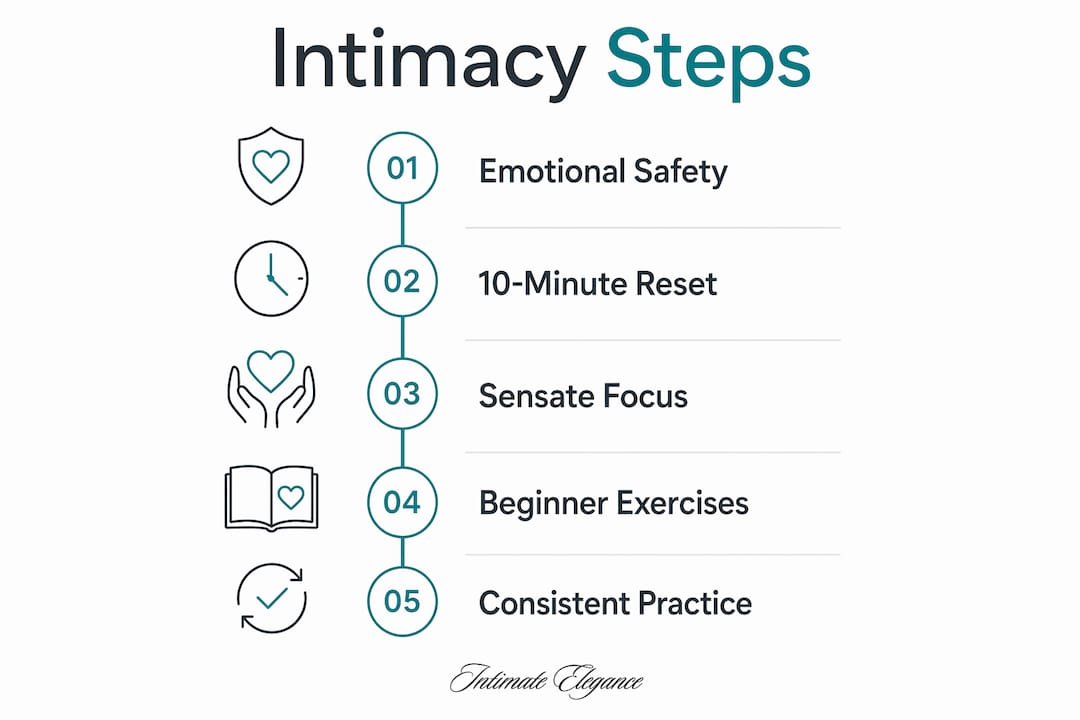
Step by step intimacy improvement is the practice of building emotional and physical closeness through structured, repeatable exercises that separate touch from sexual expectation. Clinically supported methods like Sensate Focus, developed by Masters and Johnson, and the 10-Minute Intimacy Reset give couples a clear framework to follow without pressure or performance anxiety. The approach works because it prioritises nervous system regulation and emotional safety before physical closeness. Couples who follow a gradual, consent-centred process consistently report deeper connection and less avoidance over time. This guide walks you through every stage, from foundational prerequisites to beginner exercises and beyond.
What are the emotional and physical prerequisites for intimacy growth?
Emotional safety is the non-negotiable starting point for any intimacy growth technique. Without it, physical closeness triggers the nervous system’s threat response rather than its bonding response. Nervous system regulation through proximity moves couples out of stress states and creates the biological safety that intimacy requires. That shift from guarded to receptive is what makes structured practice possible in the first place.

Consent-centred communication is the second prerequisite. The Green/Yellow/Red check-in tool gives both partners a simple, shared language for expressing comfort levels without lengthy negotiation. Green means proceed, yellow means slow down or adjust, and red means stop completely. Using this tool before and during exercises removes ambiguity and builds trust quickly.
Before you begin any practical intimacy exercises, address these foundations:
- Regulate first. Spend five minutes in the same room doing something calm, such as making tea or sitting quietly, before starting any exercise. Physical proximity without demand already begins co-regulation.
- Set expectations out loud. State clearly what the session will and will not involve. Spoken agreements reduce anticipatory anxiety significantly.
- Prepare the environment. Dim lighting, a tidy space, and switched-off phones remove distractions that pull attention away from your partner.
- Agree on a pause signal. A simple word or gesture that either partner can use at any moment keeps both people feeling safe throughout.
- Start with emotional check-ins. Ask your partner how they are feeling right now, not how they feel about the relationship in general. Specificity keeps the conversation grounded.
Pro Tip: Do not attempt intimacy exercises immediately after a conflict or a stressful day. Give yourselves at least 20 minutes of calm, neutral activity together before beginning.
Managing expectations is as important as the exercises themselves. Couples who treat the first few sessions as experiments rather than tests report far less disappointment. The goal of each session is presence, not progress.
How to implement the 10-minute intimacy reset
The 10-Minute Intimacy Reset, practised 2–4 times weekly, rebuilds closeness without pressure by focusing entirely on presence over performance. Each session is strictly time-limited, which removes the fear of things escalating beyond what either partner is ready for. That time boundary is what makes the exercise accessible even when emotional distance feels significant.
Follow these five steps in order:
- Set the frame verbally. Say something like “This is just ten minutes, no expectations.” Stating this out loud lowers anticipatory anxiety and reduces the chance of either partner withdrawing before the session begins.
- Sit close without distractions. Turn off screens, sit on a sofa or bed facing each other or side by side, and simply be present. Proximity alone begins to shift the nervous system toward receptivity.
- Introduce light, non-sexual touch. Hold hands, rest a hand on your partner’s knee, or place a hand on their back. The touch should feel warm and deliberate, not mechanical.
- Sync your attention. Make brief eye contact or breathe at the same pace for a minute or two. You do not need to speak. Shared attention deepens the sense of connection faster than conversation at this stage.
- Decide together at the ten-minute mark. Ask whether to continue, pause, or simply sit quietly for a moment longer. The decision belongs to both of you equally.
Pro Tip: Set a gentle timer so neither partner is watching the clock. Knowing the timer will signal the end frees both of you to stay present during the session.
Common beginner challenges include giggling, feeling self-conscious, or one partner feeling more engaged than the other. All of these are normal. Awkwardness signals that you are breaking an old habit, not that the exercise is failing. Persistence through that initial discomfort is what produces results.
What is Sensate Focus and how does it build closeness progressively?
Sensate Focus is a graded touch programme developed by sex researchers Masters and Johnson as a clinical tool for couples experiencing desire discrepancies or physical avoidance. Its core principle is decoupling physical touch from sexual expectation, which allows couples to rebuild comfort and curiosity at their own pace. Each stage introduces slightly more intimacy than the last, but only when both partners feel genuinely ready. You can read more about Sensate Focus progression and how it connects to broader pleasure enhancement.
The four stages progress as follows:
- Stage 1: Non-genital touch. One partner touches the other’s arms, back, face, and legs, focusing on texture and sensation rather than arousal. The receiving partner gives no feedback beyond comfort signals. Sessions last 20–30 minutes and require privacy.
- Stage 2: Including genital areas. Genital touch is introduced but without any pressure toward arousal or orgasm. The focus remains on curiosity and sensation. Both partners take turns.
- Stage 3: Mutual touching. Both partners touch each other simultaneously, following their own pace and comfort. Communication through the Green/Yellow/Red system continues throughout.
- Stage 4: Transition to sexual intimacy. Sexual activity is introduced naturally when both partners feel ready, not on a schedule. Readiness is the only criterion for moving forward.
| Stage | Focus | Typical duration per stage |
|---|---|---|
| 1: Non-genital touch | Texture and sensation, no sexual goal | 1–2 weeks |
| 2: Genital areas included | Sensation without arousal pressure | 1–2 weeks |
| 3: Mutual touching | Shared pace, ongoing communication | 1–2 weeks |
| 4: Sexual intimacy | Natural transition when both feel ready | As long as needed |
Sensate Focus sessions last 20–30 minutes and require clear boundary agreements before each one. Moving slowly through the stages is not a sign of failure. It is the method working as intended.
Which beginner exercises build emotional closeness safely?
The most accessible intimacy exercises require minimal vulnerability and fit naturally into daily life. Daily appreciation exchanges shift emotional tone over weeks by reinforcing positive feelings about your partner. The exercise is simple: each partner names one specific thing they genuinely appreciated about the other that day. Specificity matters far more than eloquence here.
Three beginner exercises worth starting with:
- The 6-Second Kiss. A six-second kiss is long enough to shift attention away from daily stress and toward your partner. It is short enough to feel low-stakes. Practise it once daily, ideally at a consistent moment such as arriving home or before bed.
- The Extended Hug. Hold each other for at least 20 seconds without speaking. Physical closeness at this duration triggers oxytocin release, which deepens the sense of bonding. It requires no skill and no planning.
- The Gratitude Walk. Walk together for 15–20 minutes and take turns sharing one thing you are grateful for, alternating between gratitude for life in general and gratitude specifically for your partner. Movement reduces social anxiety and makes honest conversation easier.
Pro Tip: Avoid attempting emotionally intense exercises, such as extended eye-gazing or vulnerability sharing, until the lower-stakes exercises feel genuinely comfortable. Build the foundation before adding weight.
Embedding these exercises into existing routines dramatically increases consistency. Attach the Daily Appreciation Exchange to a habit you already have, such as dinner or the end of a work call. Routine exercises support sustained intimacy growth far more effectively than occasional intensive sessions. Couples who strengthen their bond through small, consistent actions outperform those who rely on grand gestures.
Key takeaways
Structured, gradual intimacy practice works because it builds emotional safety before physical closeness, removing the pressure that causes most couples to stall or avoid connection altogether.
| Point | Details |
|---|---|
| Emotional safety comes first | Regulate your nervous system together before attempting any touch-based exercise. |
| Use the 10-Minute Reset | Practise 2–4 times weekly with a strict time limit to rebuild closeness without pressure. |
| Follow Sensate Focus stages | Progress through four graded stages over weeks, moving only when both partners feel ready. |
| Start with low-stakes exercises | Daily appreciation exchanges, 6-second kisses, and gratitude walks build trust before deeper vulnerability. |
| Debrief after every session | A brief five-minute check-in after each exercise keeps communication open and the process collaborative. |
Awkwardness is part of the process, not a sign it is failing
The single most common reason couples abandon intimacy exercises is discomfort in the first two or three sessions. I have seen this pattern repeatedly, and the instinct to interpret awkwardness as incompatibility or failure is almost universal. It is wrong. Initial awkwardness in intimacy practices is a natural part of breaking avoidance habits, not evidence that the approach is wrong for you.
The mindset shift that changes everything is treating each session as practice rather than performance. A musician does not expect a first rehearsal to sound like a concert. The same logic applies here. The goal of the first ten sessions is simply to show up, not to feel a particular way during them.
Attempting only one exercise at a time and including a five-minute debrief after each session keeps the process collaborative rather than one-sided. That debrief does not need to be a deep conversation. “How did that feel for you?” is enough. The question signals that both experiences matter equally.
Gradual progress is not slow progress. Couples who resist the urge to rush physical stages consistently report stronger, more lasting reconnection than those who push ahead before emotional safety is established. Patience here is not passive. It is the most active thing you can do.
— Bartosz
Tools from Intimate-elegance to complement your practice
Physical tools can deepen the sensory dimension of intimacy exercises once emotional safety is established. Intimate-elegance offers a curated selection of couples’ accessories designed to complement structured practice rather than replace it.

The TOYJOY Amazing Pleasure Sex Toy Kit is a well-regarded starting point for couples ready to introduce shared sensory exploration. For couples interested in simultaneous stimulation, the double stimulator for couples offers a straightforward way to add a new dimension to physical closeness. All products ship discreetly across the EU with secure, anonymous delivery. Explore the full range at Intimate-elegance and find options that match your current comfort level and curiosity.
FAQ
What does step by step intimacy improvement actually mean?
Step by step intimacy improvement means using structured, repeatable exercises to build emotional and physical closeness gradually. The approach prioritises nervous system regulation and consent before introducing physical touch.
How often should couples practise intimacy exercises?
The 10-Minute Intimacy Reset is most effective when practised 2–4 times weekly. Consistency across shorter, regular sessions produces better results than occasional longer ones.
What is Sensate Focus and is it suitable for beginners?
Sensate Focus is a graded touch programme developed by Masters and Johnson that begins with non-genital touch and progresses through four stages over several weeks. It is specifically designed for couples rebuilding comfort and is well-suited to beginners.
Why do intimacy exercises feel awkward at first?
Awkwardness is a natural response to breaking avoidance habits. Sex therapists confirm that initial discomfort is expected and that persistence through it is what produces lasting change.
Should couples use intimacy tools alongside these exercises?
Sensory tools can complement structured intimacy practice once emotional safety is established. Introducing them too early, before trust and comfort are in place, can increase rather than reduce pressure.
Recommended
- Intimacy tips for couples: Strengthen your bond in 2026 – Intimate Elegance
- How to introduce toys in relationships: deeper intimacy – Intimate Elegance
- Why investing in intimacy transforms your relationship – Intimate Elegance
- Enhance intimacy and connection with lingerie: a practical guide – Intimate Elegance