

What is modern intimacy: a guide for deeper connection
TL;DR:
- Modern intimacy encompasses emotional, physical, intellectual, and experiential closeness, with emotional connection serving as the foundation. Many couples struggle with desire discrepancy and attachment styles, but routine, communication, and deliberate effort can strengthen bonds. Luxury products and therapy offer additional avenues to deepen trust, explore vulnerability, and maintain long-term intimacy.
Most people assume intimacy means sex. That assumption quietly damages more relationships than almost any other misconception in adult life. What is modern intimacy, really? It is a layered, evolving exchange of emotional availability, intellectual curiosity, physical presence, and shared experience. The couples who thrive long-term are not necessarily those having the most sex. They are the ones who have learnt to be genuinely seen by each other. This guide unpacks what modern intimacy actually means, why so many couples struggle with it, and what you can do today to cultivate something far richer than physical connection alone.
Table of Contents
- Defining modern intimacy beyond physical connection
- Common challenges in modern intimacy and desire discrepancy
- The role of attachment styles and emotional intimacy in relationship satisfaction
- Practical ways to build and maintain intimacy in modern relationships
- The role of therapy and luxury adult products in enhancing modern intimacy
- Rethinking intimacy: lessons from modern experience and therapy
- Explore Intimate Elegance: luxury products for deeper connection
- Frequently asked questions
Key Takeaways
| Point | Details |
|---|---|
| Modern intimacy is multi-dimensional | Intimacy involves emotional, intellectual, physical, and experiential closeness beyond just sexual activity. |
| Communication is fundamental | Open and shame-free communication allows couples to manage desire discrepancies and deepen connection. |
| Emotional intimacy predicts satisfaction | Strong emotional bonds more reliably sustain long-term relationship happiness than physical intimacy alone. |
| Small daily gestures matter | Consistent small acts like touch and attentive listening build intimacy over time. |
| Support enhances connection | Therapy and luxury adult products can help couples overcome blocks and explore new dimensions of intimacy. |
Defining modern intimacy beyond physical connection
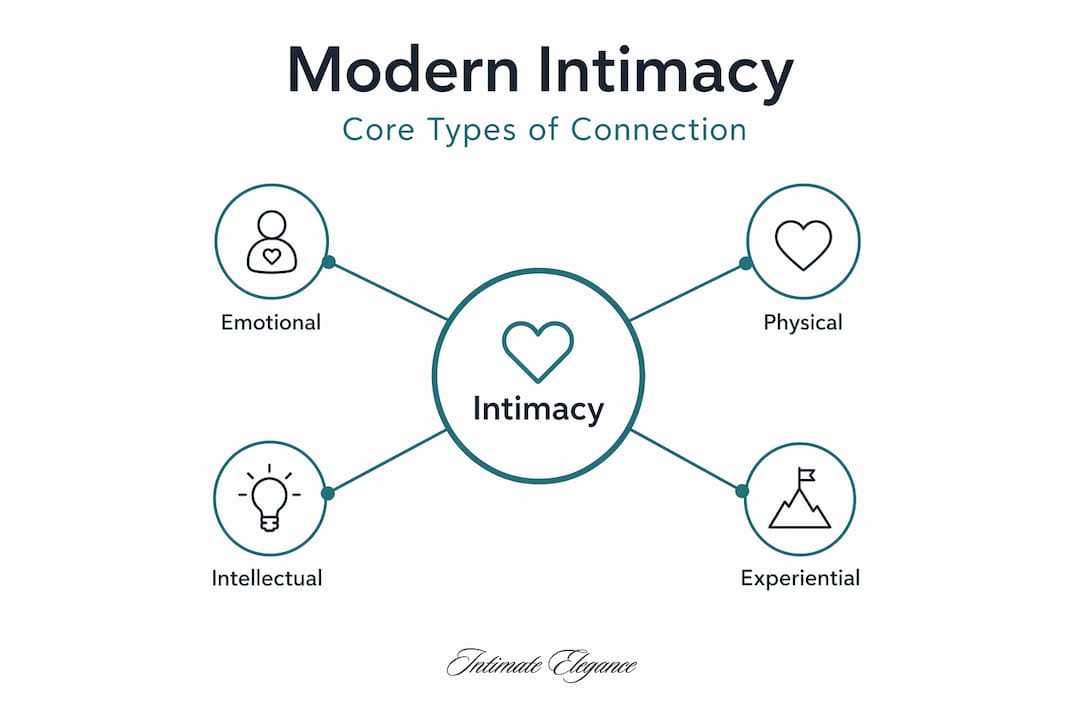
Modern intimacy is not a single act or a frequency count. Intimacy encompasses emotional, physical, intellectual, and experiential closeness, with emotional intimacy serving as the foundation upon which everything else is built. Strip that foundation away, and even a physically active relationship will feel hollow.
The definition of modern intimacy has shifted considerably over the past two decades. Where older models focused almost entirely on physical and romantic union, contemporary understanding recognises that true closeness requires vulnerability, consistent self-disclosure, and the genuine belief that your partner understands you at a level no one else does. That last part, being truly known, is what separates a deep relationship from a convenient one.
The four dimensions of modern intimacy include:
- Emotional intimacy: Sharing fears, hopes, and feelings without editing yourself for your partner’s comfort
- Intellectual intimacy: Engaging in ideas together, debating, learning, and respecting how differently each of you thinks
- Physical intimacy: Touch, warmth, and bodily presence, which extends well beyond sexual contact to include everyday affection
- Experiential intimacy: Building a shared world through activities, rituals, memories, and meaningful time spent together
What matters is not that every dimension is always perfectly balanced. It is that couples recognise when one dimension has gone quiet and treat that silence as information. You can strengthen your bond in any one of these areas and feel the ripple effect across all the others.
Now that we see intimacy’s breadth, let us explore why modern couples so often struggle to sustain it.
Common challenges in modern intimacy and desire discrepancy
One of the most underreported issues in adult relationships is desire discrepancy. This is the gap that opens when one partner wants more emotional or physical closeness than the other. It is not a sign of incompatibility. It is almost universal. 73% of couples report desire discrepancy affecting their intimacy, where mismatched needs for closeness lead to disconnection.
The problem is rarely the gap itself. The problem is what happens when the gap goes unnamed. The higher-desire partner begins to feel rejected. The lower-desire partner feels pressured. Both retreat. Over time, the silence between them grows into resentment, which is far harder to bridge than a simple difference in need.
What makes desire discrepancy worse:
- Shame around having either too much or too little desire
- Treating one partner’s level as the “correct” one
- Avoiding the conversation to preserve short-term comfort
- Confusing low desire with lack of love or attraction
The shift happens when couples treat desire as something fluid and negotiable rather than fixed. Investing in intimacy as a shared project, rather than a personal performance, gives both partners room to be honest without fear.
Pro Tip: Set aside ten minutes weekly to simply ask each other, “What kind of connection do I need most right now?” No pressure to act on the answer. The act of asking is itself an intimacy-building ritual.
Having identified what disrupts intimacy, let us examine the psychological factors that facilitate stronger intimate bonds.
The role of attachment styles and emotional intimacy in relationship satisfaction
Your attachment style, formed in early childhood through your relationship with caregivers, quietly governs how you seek and respond to closeness as an adult. Secure attachment enables 80% higher intimacy levels in adulthood through consistent emotional responsiveness. This does not mean those with anxious or avoidant styles are doomed. It means they have more to learn consciously.

The meaning of intimacy today is inseparable from this psychological foundation. If you are anxiously attached, you may pursue closeness in ways that inadvertently push partners away. If you are avoidantly attached, you may shut down precisely when a partner most needs your presence. Understanding your pattern is the first step toward changing it.
| Attachment style | Typical intimacy behaviour | Path to greater closeness |
|---|---|---|
| Secure | Comfortable with closeness and independence | Maintain consistency; model openness for partner |
| Anxious | Seeks frequent reassurance; fears abandonment | Practise self-soothing; communicate needs directly |
| Avoidant | Withdraws when intimacy intensifies | Gradually extend emotional tolerance in small steps |
| Disorganised | Desires and fears closeness simultaneously | Therapeutic support is most effective here |
Why emotional intimacy matters most:
- Emotional intimacy predicts satisfaction more reliably than physical intimacy in 85% of long-term marriages
- Partners who feel emotionally safe are far more likely to take physical and sexual risks together
- Consistent emotional responsiveness builds trust over months and years, not weeks
- Emotional closeness acts as a buffer during conflict, reducing the damage arguments cause
This is also where your deeper connection guide can be most useful. Understanding your attachment tendencies and working with them deliberately is one of the most impactful things you can do for your relationship.
Understanding emotional intimacy’s power leads naturally to how couples can actively nurture it in daily life.
Practical ways to build and maintain intimacy in modern relationships
Here is where theory becomes habit. The research is unambiguous: small, consistent acts of connection are the most powerful intimacy tool available to couples. Grand gestures matter far less than the texture of your ordinary days together.
How to build modern intimacy, step by step:
-
Start with a daily, non-negotiable moment of contact. A two-minute hug in the morning, eye contact over coffee, a hand held during a television programme. These seem trivial. They are not. Non-sexual touch like cuddling releases oxytocin and builds intimacy more sustainably than sex alone because it carries no performance pressure.
-
Establish a weekly relationship check-in. This is not a conflict resolution session. It is a brief, structured conversation: what felt good this week, what felt distant, and one thing you appreciate about your partner. Twenty minutes, once a week, consistently applied over three months will alter the emotional tone of your relationship.
-
Practise verbal acknowledgement. Naming what you notice, “I saw how hard you worked today,” or “I love the way you handled that,” is a form of emotional intimacy many couples overlook entirely because it feels awkward at first.
-
Introduce sensual exploration with intention. Sensual massage is one of the most research-supported tools for rebuilding physical intimacy without the pressure of sexual performance. It trains partners to be present with each other’s bodies in a wholly different register.
-
Use adult products thoughtfully as an extension of play. When incorporated with open communication and mutual curiosity, adult toys enhance connection by introducing novelty and shared exploration that reinvigorates the physical dimension of intimacy.
Pro Tip: The intimacy tips for couples that work best are those you both agree to in advance. Do not introduce a new ritual unilaterally. Negotiate it. That negotiation is itself an act of intimacy.
With these tools in hand, let us explore how professional guidance and luxury adult products can further support modern intimacy.
The role of therapy and luxury adult products in enhancing modern intimacy
Sometimes the habits above are not enough, not because you lack will, but because certain blocks require a different kind of space to surface. Sex therapy provides exactly that. Sex therapy over 3 to 6 months rebuilds emotional and physical closeness in 70% of couples. That is a striking figure, and it reflects the fact that most intimacy problems are communication problems wearing a different costume.
A skilled sex therapist does not prescribe specific acts. They help partners articulate needs they have never found language for, identify shame-based patterns that block closeness, and build the trust necessary to be genuinely vulnerable with another person.
What therapy and considered product exploration share in common:
- Both work best when entered with curiosity rather than urgency
- Both require consent, communication, and a willingness to be surprised
- Both introduce a structured space for experimentation outside ordinary routines
- Both shift the frame from “fixing a problem” to “building something together”
Knowing how to introduce toys into a relationship thoughtfully is itself a form of intimate communication. The conversation around it, the consent, the shared selection, often matters as much as the product itself. If you are new to this space, a clear sex toy guide can help you and your partner navigate options without pressure.
Having covered external support, let us share a perspective that reshapes common views on what intimacy actually requires.
Rethinking intimacy: lessons from modern experience and therapy
Here is the view we rarely see stated plainly: high desire frequency is not a measure of intimacy. Two people can have sex frequently and be completely emotionally alone together. Conversely, a couple navigating a period of low sexual contact can be profoundly intimate if they remain emotionally available, curious, and honest with each other.
The therapist and author Esther Perel has articulated this most usefully. The balance of closeness and eroticism is vital: security without novelty fades desire after two to three years. This is not a personal failure. It is a relational dynamic that requires active management. Familiarity is wonderful for trust. It is not always wonderful for desire. The couples who navigate this successfully treat erotic novelty as something they deliberately create together, not something that either exists naturally or does not.
What this means practically is that intimacy in contemporary relationships requires intentional negotiation. You cannot coast on attraction or chemistry indefinitely. You need to keep choosing each other, keep being curious about each other, and keep introducing experiences that disrupt the comfortable predictability that erodes desire over time.
This is why investing in your intimate relationship deserves the same seriousness you give your career or your health. It is not indulgent. It is maintenance. And the return is a relationship that actually nourishes you.
Explore Intimate Elegance: luxury products for deeper connection
Understanding what modern intimacy means is one thing. Having tools to express and deepen it is another.

At Intimate Elegance, our curated collection is designed with exactly this in mind. Whether you are looking to introduce sensory play, reinvigorate physical closeness, or simply create a shared ritual that feels luxurious and playful, our products are chosen for quality, comfort, and aesthetic beauty. The Coquette Chic Desire Lace Mask is a beautiful starting point for couples exploring sensory intimacy, crafted in delicate lace to enhance trust and presence. Browse our full collection, including the Coquette Chic Desire lace mask range, and discover how thoughtfully chosen products can become part of your intimacy practice. All orders ship discreetly across the EU.
Frequently asked questions
What are the main types of intimacy in modern relationships?
Modern intimacy includes emotional, physical, intellectual, and experiential types, with emotional intimacy acting as the foundation from which deeper connection in all other areas tends to grow.
How can couples manage desire discrepancy effectively?
By naming the gap openly and without shame, listening to each other’s needs without judgement, and seeking support around desire through couples therapy when the pattern feels entrenched rather than situational.
Does emotional intimacy matter more than physical intimacy?
Yes, and the evidence is clear. Emotional intimacy predicts satisfaction in long-term partnerships more reliably than physical intimacy, which means it deserves at least as much intentional investment.
How do luxury adult products contribute to intimacy?
When introduced with open communication and mutual curiosity, luxury adult products support playful exploration, build trust through shared experience, and add the erotic novelty that sustains desire alongside emotional closeness.
Recommended
- Why investing in intimacy transforms your relationship – Intimate Elegance
- Intimacy tips for couples: Strengthen your bond in 2026 – Intimate Elegance
- Intimate wellness: what it means and why it matters – Intimate Elegance
- Enhance intimacy and connection with lingerie: a practical guide – Intimate Elegance