

Why explain adult product terminology: 2026 guide
TL;DR:
- Adult product terminology provides clear labels for understanding product functions, materials, and usage, leading to safer, more informed purchases. Inconsistent language causes consumer confusion, overspending, and safety risks, especially with vague marketing names and supplier terminology variability. Industry efforts to standardize vocabulary improve listing accuracy, consumer confidence, and safety in the sexual wellness market.
Adult product terminology is the set of precise, functional labels that define what a sex toy, accessory, or intimacy device actually does, how it is made, and how it is used. Without these definitions, consumers waste money, make unsafe choices, and miss out on products that genuinely suit their needs. Understanding adult product terms is not a luxury. It is the foundation of confident, informed shopping in the sexual wellness market.
Why explain adult product terminology at all?
The adult wellness industry generates billions in annual revenue, yet its product language remains inconsistent across retailers, suppliers, and marketplaces. That inconsistency has a direct cost. Terminology confusion around categories like sex swings and installation methods causes consumers to overspend by approximately $200 on unsuitable equipment. That figure represents a real, avoidable loss rooted entirely in unclear language.

The importance of adult terminology goes beyond saving money. When a product listing says “freestanding sex swing,” many shoppers assume “freestanding” describes the swing itself. It actually describes the mounting method, not the product type. A strap-based swing and a leather panel sling are fundamentally different products. Both can be freestanding. Conflating product type with installation method is one of the most common errors in adult product listings today.
Drop shipping and private label supply chains make this worse. Suppliers feed product data into retailer catalogues using their own naming conventions. One supplier calls it a “sex sling.” Another calls the identical product a “sex swing.” A third labels it a “couples’ support harness.” The shopper sees three different names and assumes three different products. The adult product language explained across these feeds is rarely standardised, and the consumer pays the price.
Pro Tip: When reading any adult product listing, ignore the headline name entirely. Read the functional description: what it is made from, how it attaches, and what body positions it supports. That information is always more reliable than the marketing title.
What terms cause the most confusion for shoppers?
Several product categories generate disproportionate confusion because their names blend function, installation, and sensation into a single, vague phrase.
- Sex swing vs sex sling. A sex swing typically uses straps and hangs from a single point. A sex sling uses a wider support panel and often requires a frame or spreader bar. Many listings use both terms interchangeably.
- Vibrator vs stimulator. A vibrator produces oscillating vibrations. A stimulator is a broader category that includes air pulse devices, suction toys, and electrostimulation products. Calling every stimulator a vibrator misrepresents the mechanism entirely.
- BDSM restraints vs bondage accessories. Restraints are functional items designed to limit movement. Bondage accessories include decorative items, rope, and sensory tools that may not restrict movement at all.
- Body-safe vs non-toxic. These are not the same claim. Body-safe refers to materials that are non-porous and free from harmful plasticisers. Non-toxic is a weaker, less regulated term that some suppliers use to describe products that still contain phthalates.
Retail adult product descriptions frequently prioritise purchase triggers over functional clarity. Industry experts advocate a functional-term focus as the only reliable way to cut through marketing noise.
How does terminology improve shopper confidence and safety?
Precise vocabulary is a safety tool, not just a shopping aid. This is most visible in BDSM, where misunderstood terms like D/s and TPE can lead to harmful dynamics. D/s refers to a Dominant and submissive relationship structure. TPE stands for Total Power Exchange, a far more intensive arrangement involving near-complete authority transfer. Treating these as synonyms creates serious consent and safety risks.
“Precise language in adult wellness acts more like a map guiding safe and inclusive experience rather than a verdict, promoting trust.” — Industry insight on vocabulary and empowerment
The frameworks SSC (Safe, Sane, Consensual) and CNC (Consensual Non-Consent) are not simply jargon. They are critical negotiation frameworks that define the boundaries of any kink interaction. Knowing the difference between them before entering a dynamic is not optional. It is the difference between a positive experience and a harmful one.
The psychological benefits of clear language are equally significant. Adults who understand the correct terms for what they want report reduced shame and greater self-understanding. When you can name a product accurately, you can research it, discuss it with a partner, and assess whether it genuinely fits your needs. Vague or euphemistic language, by contrast, forces shoppers to guess, and guessing in this category carries real emotional and physical risk.
- Clear material labels (silicone, ABS plastic, TPE) allow you to assess body safety before purchase.
- Accurate function descriptions (clitoral suction, internal vibration, dual stimulation) let you match a product to your anatomy and preferences.
- Precise BDSM terminology supports negotiation, consent, and aftercare planning.
Pro Tip: Before purchasing any product in a new category, spend five minutes with a reputable glossary. The BDSM terms glossary at BDSMTestSynr covers over 80 definitions and is a reliable starting point for kink-adjacent purchases.
What practical strategies help you decode adult product language?
Understanding adult product terms becomes straightforward once you apply a consistent framework to every listing you read.
- Prioritise functional descriptions over names. Look for vibration type, power source, material composition, and dimensions. These facts do not change regardless of what a supplier calls the product.
- Separate product type from installation method. For swings, slings, and frames, ask: what is the product itself, and what does it attach to? These are two separate questions that many listings blur into one.
- Check material claims against recognised standards. Body-safe silicone should be non-porous, phthalate-free, and compatible with water-based lubricants. If a listing says “silicone-like” or “silicone blend,” treat that as a red flag.
- Use glossaries from trusted sources. Guides like the sex toy selection guide at Intimate-elegance explain functional categories clearly and without patronising language.
- Approach private label and drop ship listings with caution. These products often carry invented names that bear no relation to industry conventions. Focus entirely on the specification table, not the product title.
| Approach | What It Tells You |
|---|---|
| Read the material specification | Whether the product is body-safe and compatible with your lubricant |
| Check the installation requirements | Whether you need additional hardware, ceiling fixings, or a frame |
| Verify the stimulation mechanism | Whether the product vibrates, pulses, suctions, or uses electrostimulation |
| Cross-reference with a glossary | Whether the marketing name matches the functional category |
For products involving cleaning and maintenance, understanding material terminology also determines which cleaning method is safe. Silicone, glass, and stainless steel can be sterilised. Porous materials like TPE cannot. The safe cleaning methods guide at Intimate-elegance breaks this down by material type and is worth bookmarking alongside any purchase.
How are industry standards addressing terminology in 2026?
The adult product industry is actively working to standardise vocabulary across marketplaces, and 2026 has seen measurable progress. Taxonomy projects led by supply chain platforms like Inventory Source now use structured vocabularies and automated validation tools to prevent policy-triggering language from entering product feeds. This matters because a single non-compliant term in a product title can trigger listing suppression on major marketplaces, removing the product from search results entirely.
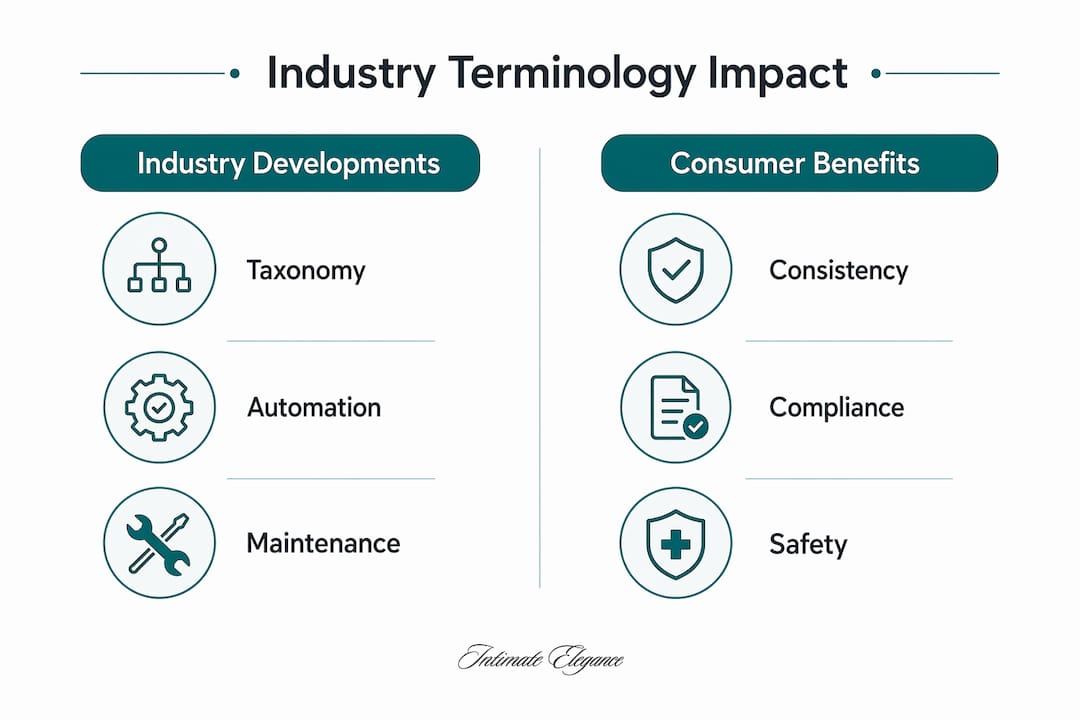
Taxonomy standardisation reduces listing suppression risk and improves compliance across adult product marketplaces. For consumers, this means that products listed on compliant platforms are more likely to carry accurate, consistent descriptions. The benefit flows directly to the shopper.
Automated content governance engines now flag terms that conflict with marketplace policies before a product goes live. These systems enforce vocabulary rules at the point of data ingestion, not after a listing is already published. The result is a cleaner, more reliable product catalogue for buyers.
The challenge is that marketplace policies remain in flux throughout 2026. Continuous vocabulary maintenance is required because the rules governing acceptable terminology update regularly. Consumers who understand why these standards exist are better placed to interpret listing language and spot products that have slipped through without proper categorisation.
| Industry Development | Consumer Benefit |
|---|---|
| Structured taxonomy vocabularies | More consistent product names across retailers |
| Automated feed validation | Fewer misleading or policy-violating descriptions |
| Ongoing vocabulary audits | Listings stay current with marketplace standards |
| Functional term enforcement | Product descriptions reflect actual use, not marketing spin |
Key takeaways
Precise adult product terminology is the single most effective tool for making safer, more satisfying purchases in the sexual wellness market.
| Point | Details |
|---|---|
| Terminology confusion costs money | Unclear labels cause consumers to overspend by approximately $200 on unsuitable products. |
| Functional terms outperform marketing names | Focus on material, mechanism, and installation requirements rather than product titles. |
| Clear BDSM vocabulary is a safety requirement | Terms like SSC, D/s, and TPE define consent and risk boundaries, not just preferences. |
| Industry standardisation is improving | Taxonomy projects and automated validation tools are making adult product listings more reliable in 2026. |
| Glossaries are your most reliable resource | Trusted guides from platforms like Intimate-elegance give you accurate definitions without vague marketing language. |
Why language is the most underrated tool in sexual wellness
I have spent years reading adult product listings, testing descriptions, and watching shoppers make avoidable mistakes. The pattern is always the same. Someone buys a product based on a name they half-recognise, receives something that does not match their expectation, and either returns it or gives up on that category entirely. The product was not the problem. The language was.
What frustrates me most is how often the industry defaults to euphemism when precision would serve everyone better. Calling a clitoral air pulse device a “pleasure wand” tells you nothing useful. Calling it an air pulse stimulator with variable pressure settings tells you exactly what to expect. Applying precise language signals competence and inclusivity. Vague language signals the opposite.
The same principle applies in BDSM contexts. Adults who approach kink with a clear vocabulary are not just better informed. They are safer, more confident, and more capable of communicating their needs to a partner. Educational content that respects adult dignity and avoids a patronising tone increases information retention and practical application. That is not a minor stylistic point. It is the difference between content that actually helps and content that gets ignored.
My honest view is this: the benefits of knowing adult terms extend far beyond shopping. Precise vocabulary gives you agency. It lets you advocate for what you want, decline what you do not, and engage with your own sexuality from a position of knowledge rather than guesswork. That is worth more than any individual product purchase.
— Bartosz
Explore intimate-elegance’s curated collections with confidence
Now that you understand how adult product vocabulary works, you are ready to shop with real confidence. Intimate-elegance is built on the principle that clear descriptions and quality standards go together. Every product listing on the platform prioritises functional detail over vague marketing language, so you know exactly what you are buying before you commit. From vibrators and stimulators to couples’ accessories and lingerie, the full product range is described with the precision this category deserves. Discreet EU-wide shipping, secure transactions, and a blog packed with honest guidance make Intimate-elegance the natural next step for adults who take their sexual wellness seriously. Browse the pleasure device selection guide to put your new vocabulary to immediate use.
FAQ
What does “body-safe” actually mean in adult products?
Body-safe means a product is made from non-porous, phthalate-free materials such as medical-grade silicone, borosilicate glass, or stainless steel. These materials do not harbour bacteria and are safe for internal use.
Why do sex swing listings use so many different names?
Terminology inconsistency across supplier feeds means the same product appears under multiple names depending on the retailer. “Sex swing,” “sex sling,” and “couples’ support harness” often describe identical products from different suppliers.
What is the difference between SSC and CNC in BDSM?
SSC stands for Safe, Sane, Consensual and is the standard framework for kink interactions. CNC stands for Consensual Non-Consent and describes a specific negotiated scenario where one party agrees in advance to apparent non-consent. They are not interchangeable.
How can i tell if a product description is reliable?
Reliable descriptions include specific material names, stimulation mechanism types, dimensions, and power source details. Listings that rely on adjectives like “luxurious” or “powerful” without functional specifics are prioritising sales language over accuracy.
Does industry terminology change over time?
Adult product vocabulary does evolve, particularly as marketplace policies update. In 2026, automated taxonomy tools are actively enforcing vocabulary standards, which means listings on compliant platforms are more accurate than they were two years ago.